Scientific Classification
| Kingdom: Animalia |
| Phylum: Mollusca |
| Class: Cephalopoda |
| Order: Ammonoidea |
| Family: Scaphitidae |
| Genus: Hoploscaphites |
| Species: Hoploscaphites nicolletii (Morton, 1842) |
Information
Geological Range
Paleogeographic Distribution
Stratigraphic Occurrences
| Fox Hills Formation |
| Trail City Member |
| Timber Lake Member |
| Pierre Formation |
References
Morton, S. G. 1842. Description of some new species of organic remains of the Cretaceous Group of the United States with a tabular view of the fossils hitherto discovered in this formation. Journal of the Academy of Natural Sciences of Philadelphia 8(2): 207-227. [p. 209, pl. 10, fig. 3].
Remarks
Original presentation: Ammonites nicolletii Morton, 1842.
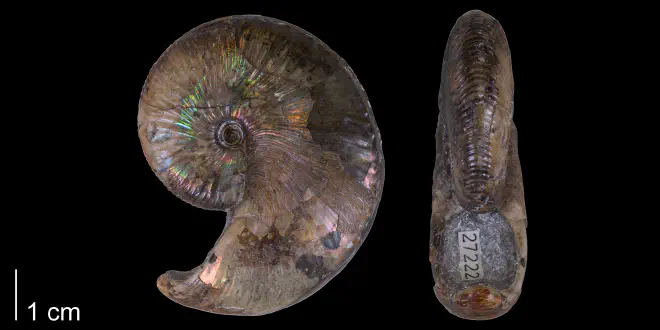
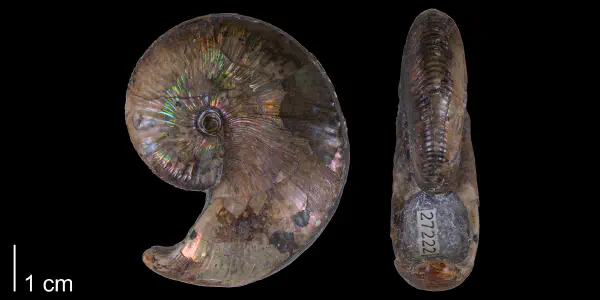
Neotype: YPM 27222 (plaster cast of Morton’s type is ANSP 51563).
Type locality: unknown (see Landman and Waage, 1993).
Zonation: Hoploscaphites nicolletii zone (Cobban et al., 2006).
Synonyms:
?Ammonites mandanensis Morton, 1842 (source: Landman and Waage, 1993).
?Ammonites abyssinus Morton, 1842 (source: Landman and Waage, 1993).
Origin of name: Named for Joseph Nicolas Nicollet, “who explored and mapped the upper Mississippi River Valley and collected Cretaceous fossils in South Dakota in 1839” (Cobban et al., 2006, p. 33).
Original description:
A. Nicolletii. PI. 10, fig. 3. “Shell convex, rapidly enlarging towards the mouth, with at least two volutions, one received deeply into the other ; costae delicate, gently curved, and bifurcate towards the convex dorsal periphery, which they cross in arched lines, between numerous minute tubercles.
I have much pleasure in dedicating this interesting species to my friend Mr. Nicollet, whose zeal and intelligence have contributed largely to the development of American science.
Some years since I saw several specimens of Ammonites which were obtained by Judge Bry, in the township of Wachita, in Louisiana. I have elsewhere (Synop. p. 24,) considered them as indications of cretaceous deposits; and my recollection induces me to believe that their characters correspond either to A. abyssinus or A. Nicolktii.”
Online Resources
Media
Images