Scientific Classification
| Kingdom: Animalia |
| Phylum: Mollusca |
| Class: Bivalvia |
| Order: Arcoida |
| Family: Arcidae |
| Genus: Anadara |
| Species: Anadara santarosana (Dall, 1898) |
Information
Geological Range
Paleogeographic Distribution
Stratigraphic Occurrences
| Shoal River Formation |
| Chipola Formation |
| Oak Grove Sand |
References
Dall, W. D. 1898. Contributions to the Tertiary fauna of Florida with especial reference to the Silex Beds of Tampa and the Pliocene beds of the Caloosahatchie River including in many cases a complete revision of the generic groups treated of and their American Tertiary species. Part IV. I. Prionodesmacea: Nucula to Julia. II. Teleodesmacea: Teredo to Ervilia. Transactions of the Wagner Free Institute of Science of Philadelphia, 3(4): i-viii, pp. 571-947, pls. 13-35. BHL.
Remarks
Original Description
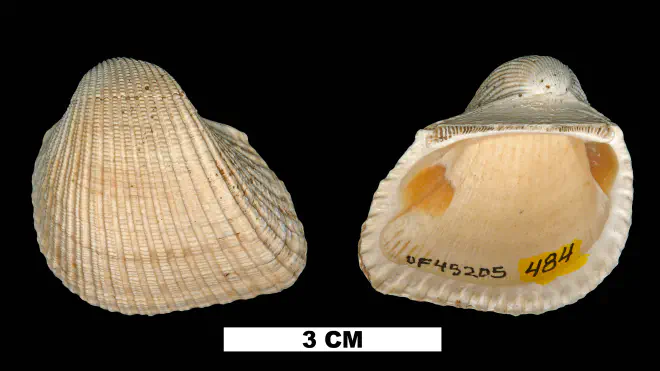
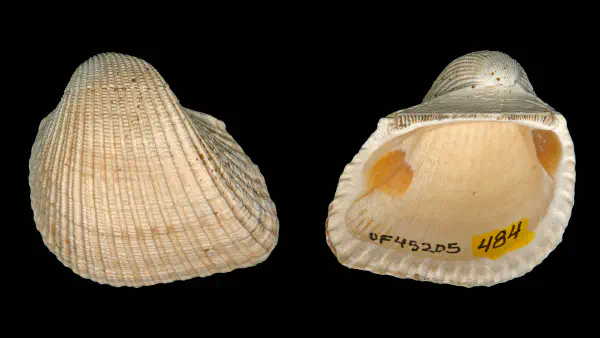
From Dall (1898, p. 641): “Oligocene of the Chipola River marl, of the lower bed at Alum Bluff, of the Sopchoppy limestone, and of the Oak Grove sands, Santa Rosa County, Florida; Burns and Dall. Shell small, short, plump, rostrate, with moderately elevated, mesially sulcate prosocoelous beaks; left valve with thirty elevated, squarish, radial ribs, separated by slightly narrower channelled interspaces; the ribs on the posterior slope are low, smaller, and nearly smooth; those on the middle of the shell have mostly near the margin a shallow mesial sulcus; in those still more anterior the sulcus is deeper and wider, dividing each rib over most of its length into two more or less rounded riblets; concentric sculpture of regularly spaced elevated lines, which on the ribs appear as prominent ripples; right valve having the ribs narrower and less strongly sculptured, and the sulci less distinct; cardinal area short, with about three concentric grooves; beaks within the anterior fourth; hinge-line short, with about fifty-seven rather irregular, closely adjacent, nearly vertical teeth, longer and more oblique distally; margins strongly fluted; base flexuous, posterior end narrow, pointed, without any marked angle at the end of the hinge-line. Lon. 36.5, alt. 28, diam. 28 mm. This species is most nearly related to A. staminata Dall, from which it can be distinguished especially by its lower beaks, more oblique posterior slope, more flexuous base, and attenuated posterior end.”
Online Resources
Media
Images